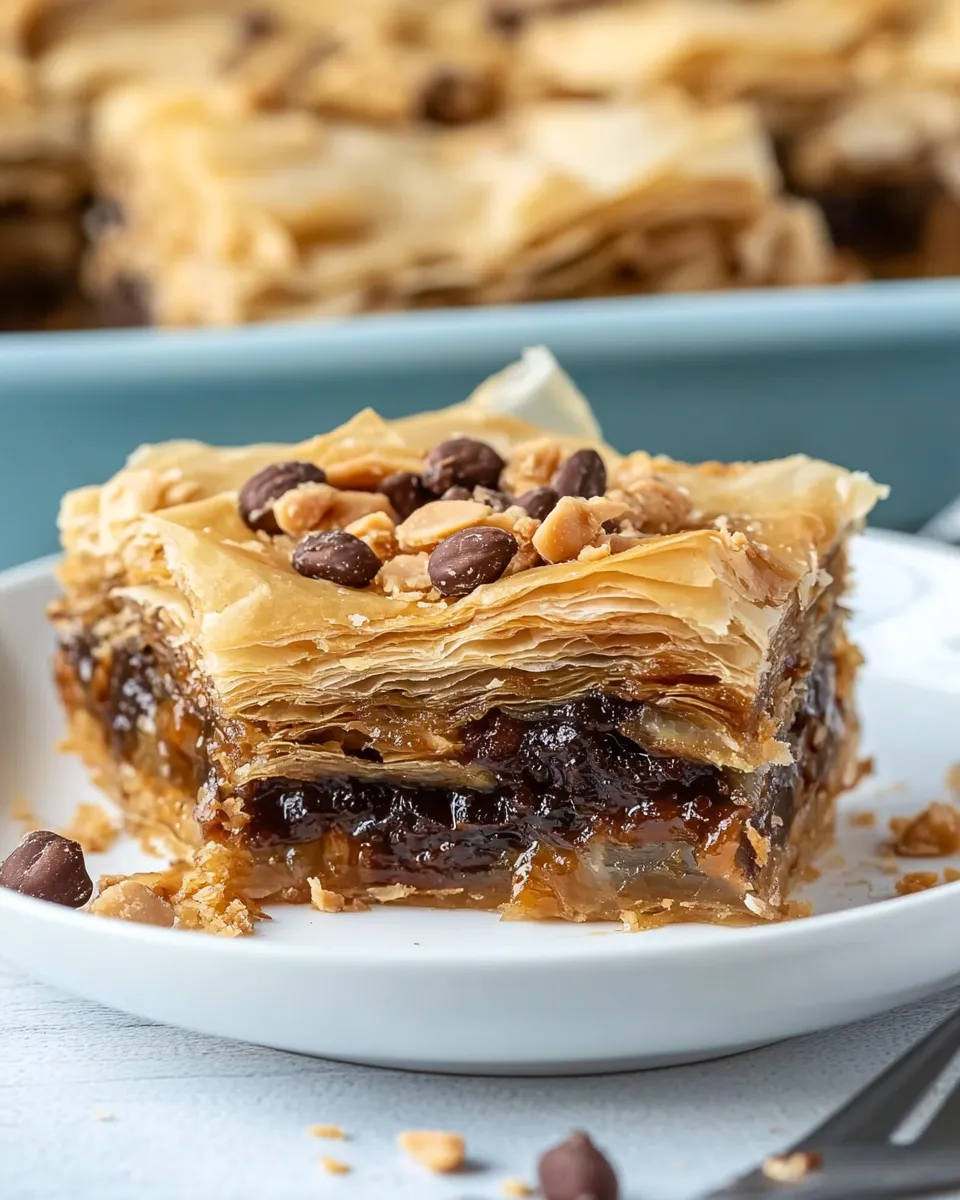
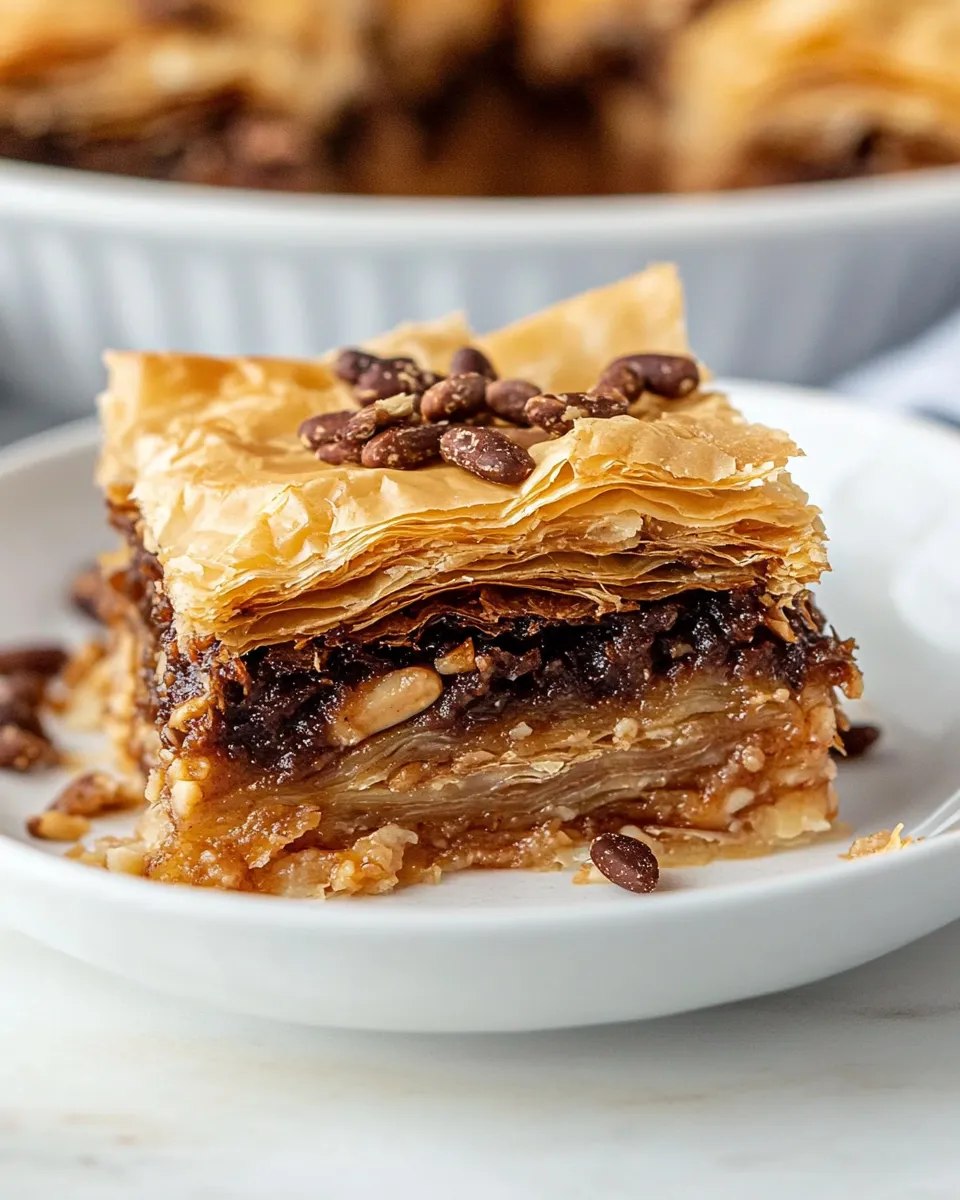
Peanut Butter Baklava is a simple mash-up of two favorite worlds: the crisp, paper-thin layers of phyllo and the familiar comfort of peanut butter and chocolate. It bakes up like classic baklava, but the filling replaces chopped nuts and spice with a straightforward peanut-butter layer and scattered chocolate chips. The result is buttery, flaky sheets that hold thin ribbons of peanut butter and pockets of melted chocolate—an approachable dessert that travels well and keeps for days if stored correctly.
I tested this version to be forgiving: it uses pairs of phyllo sheets so they handle better and get an even smear of peanut butter without tearing. The syrup is a straightforward honey-sugar mix with a touch of vanilla; pour it hot over the hot pastry so the syrup sinks into the cuts and glues the layers together. Timing and keeping phyllo covered are the two small tasks that make this recipe predictable.
Below you’ll find the exact ingredient list, step-by-step directions as written, practical hardware notes, troubleshooting tips and simple serving and storage guidance. If you want variations, I’ll give seasonal ideas and trade-offs without changing the original recipe’s quantities so you can follow this recipe exactly and then tweak with confidence.
What You’ll Need
Ingredients
- 12 ounces (approx 340 g) Phyllo Dough (defrosted, see note) — the crisp, flaky foundation; keep it covered to prevent drying.
- ½ cup (113 g) unsalted butter, melted — brushes between phyllo pairs for browning and richness.
- 1 cup (268 g) peanut butter — the main filling; warm briefly so it spreads thinly.
- 1½ cups (255 g) chocolate chips — scattered across layers for pockets of melted chocolate.
- 1 cup (200 g) granulated sugar — used in the syrup to sweeten and preserve the baklava.
- 1 cup (237 ml) water — dilutes and cooks the syrup to the right consistency.
- ½ cup (186 g) honey — adds depth and a classic baklava note to the syrup.
- 1 teaspoon vanilla — brightens the syrup without overpowering the peanut-chocolate flavors.
Directions: Peanut Butter Baklava
- Preheat the oven to 350°F (175°C). Place the ½ cup melted butter in a small bowl with a pastry brush. Put the 1 cup peanut butter in a microwave-safe bowl and heat 30–60 seconds, stirring until pourable. Put the 1½ cups chocolate chips in a bowl. Thoroughly butter a 9×9″ pan with some of the melted butter.
- Unwrap the phyllo dough and cut it in half so the sheets fit the 9×9″ pan. Keep the unused phyllo covered with the included plastic and a damp kitchen towel at all times to prevent drying.
- Make the bottom layers: lay one phyllo sheet on your work surface. Brush the top surface of that sheet with melted butter, then lift that sheet together with the sheet immediately beneath it and place both in the pan with the buttered surface facing down (the butter will be between the two sheets). Repeat two more times so the pan has a total of six phyllo sheets (three pairs) on the bottom. Cover the remaining phyllo with the plastic/damp towel.
- Add the first filling layer: pour about 2–3 tablespoons of the warmed peanut butter onto the phyllo and spread it into an even thin layer (leave a small margin at the edges). Sprinkle a portion of the chocolate chips evenly over the peanut butter.
- Build stacked filling layers: for each additional peanut-butter layer, brush the top sheet of phyllo with melted butter, lift it together with the sheet beneath, and place the two sheets (butter side down) on top of the previous filling. Spoon about 2–3 tablespoons peanut butter onto each filling layer and sprinkle chocolate chips. Continue this sequence—phyllo pair, peanut butter, chocolate chips—until you have used all 1 cup peanut butter and have distributed the 1½ cups chocolate chips roughly evenly across the filling layers.
- Finish with top phyllo layers: after the last peanut-butter/chocolate layer, place three more phyllo pairs (six sheets total) on top using the same brush-and-place method (brush the top sheet before lifting each pair). Brush the very top sheet with remaining melted butter so the top is evenly buttered.
- Using a sharp knife, score/cut the unbaked baklava all the way through into squares or diamonds so the syrup can soak into the cuts later.
- Bake the baklava in the preheated oven about 45 minutes, or until the top is golden brown.
- While the baklava bakes, make the syrup: combine 1 cup water, 1 cup granulated sugar, ½ cup honey, and 1 teaspoon vanilla in a saucepan. Bring to a boil, then reduce the heat to the lowest setting and keep warm (do not boil aggressively) until the baklava comes out of the oven.
- When the baklava comes out of the oven, immediately and evenly pour the warm honey-sugar mixture over the hot baklava, making sure to pour into the cuts so the syrup reaches all layers.
- Let the baklava cool completely, uncovered, for several hours so the syrup is absorbed and the layers set before serving.
What Sets This Recipe Apart
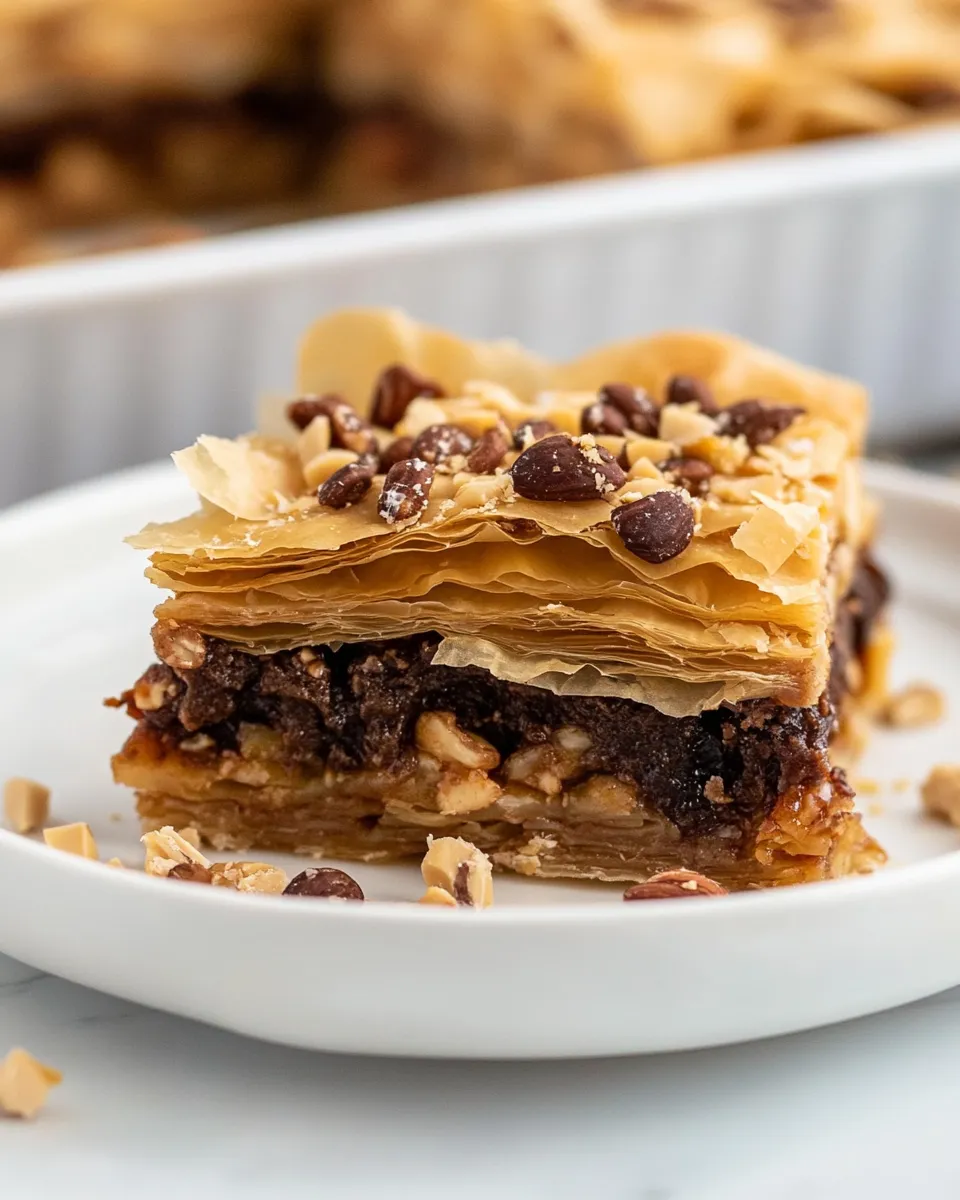
This version pares baklava down to a riff that replaces the traditional nut crumble with smooth peanut butter and chocolate chips. The technique—pairing phyllo sheets, brushing between pairs, and scattering chocolate—keeps assembly quick and yields even browning and crispness. The syrup is uncomplicated: honey plus sugar, a familiar combo that soaks in and sets without needing long reductions or citrus additions.
Unlike nut-heavy baklava, this recipe is forgiving with texture. The peanut butter melts into thin ribbons rather than creating crunch, and the chocolate chips soften into pockets. If you want a less sweet finish, the syrup’s sweetness can be tempered by shorter soaking (cool longer before serving) or by serving smaller pieces; the recipe itself remains the same.
International Equivalents
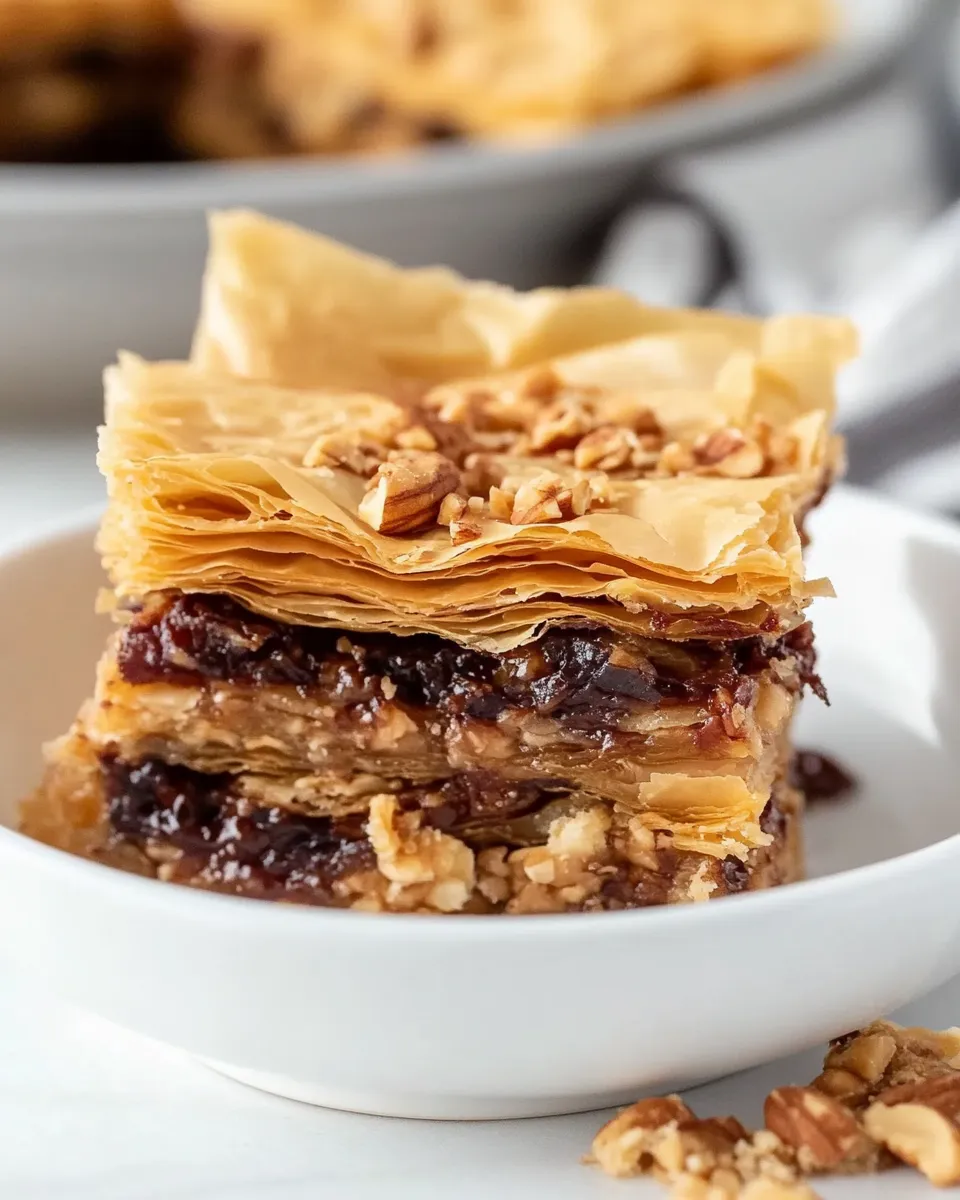
Measurements in the recipe are given in cups and ounces; if you work in metric, the ingredient list includes grams and milliliters for the main items so the quantities translate cleanly. A 9×9″ pan is a common North American square pan; think of it as roughly 23×23 cm.
Culinary names differ by region—phyllo (or filo) dough may appear under either spelling. Similarly, “granulated sugar” is standard white sugar in most countries; honey and vanilla are global pantry staples. The baking temperature 350°F (175°C) is a conventional moderate oven setting and should work in gas or electric ovens worldwide.
Hardware & Gadgets
- 9×9″ baking pan — the recipe is scaled for this size; using a significantly different pan will change baking time and layer thickness.
- Pastry brush — for an even coat of melted butter between phyllo pairs.
- Sharp knife — to score the unbaked baklava cleanly so syrup can penetrate.
- Microwave-safe bowl and small saucepan — for warming peanut butter and preparing syrup respectively.
- Damp kitchen towel and plastic wrap — critical for keeping phyllo flexible and preventing tearing.
Watch Outs & How to Fix
Phyllo dries out quickly and becomes brittle. If a sheet tears, don’t stress: brush the neighboring area with a little butter and lay the next sheet over it. The butter acts as glue and hides small imperfections.
If the peanut butter is too thick to spread, it will tear the phyllo. Warm it just enough to loosen—30–60 seconds in the microwave as the directions say. Stir until pourable but not runny; you want a spreadable ribbon, not a liquid.
If the top browns too fast while the interior still seems pale, tent the pan loosely with foil for the latter part of baking. Conversely, if the top is pale and the total time has elapsed, give it another 5–10 minutes, watching closely so it doesn’t burn.
Syrup problems: if you pour syrup that’s too cool onto hot baklava, it won’t absorb well and the pastry will remain dry; pour it warm over the hot pastry. If the syrup is boiling aggressively while the baklava bakes, reduce the heat—maintain a gentle warmth so it’s ready and won’t cook down too far before use.
Spring to Winter: Ideas
Spring and summer service: slice into small squares and serve at room temperature with a dusting of powdered sugar or a side of fresh fruit to cut the richness. The pastry keeps well for picnic-style serving and travels easily if covered and kept cool.
Fall and winter service: serve slightly warmed (gently, to avoid melting all the syrup) alongside coffee or tea. The honey-forward syrup and the peanut-butter warmth pair well with spiced drinks. For holiday tables, cut into decorative diamonds and present on a platter—this dessert scales nicely for a crowd.
Chef’s Rationale
I chose pairs of phyllo because individual sheets are fragile and easier to brush and move in pairs. Brushing only the top sheet of each pair places butter between sheets once they’re stacked, which gives the layers structure and creates that classic flake without excessive handling.
Warmed peanut butter spreads thinly without pooling. The method of alternate phyllo pairs and thin peanut-butter layers ensures that each bite has a balance of crisp pastry and a controlled amount of filling. Scattering chocolate chips rather than fully melting chocolate keeps pleasant pockets of chocolate instead of turning every layer into a continuous chocolate sheet.
Store, Freeze & Reheat
Store: Keep covered at room temperature for up to 3 days. The syrup preserves the layers, but refrigeration will firm the syrup and alter texture. If your kitchen is hot, store loosely covered in a cool spot for 2–3 days.
Freeze: Baklava can be frozen, wrapped tightly in plastic and then foil. Freeze for up to 1 month. Thaw overnight in the refrigerator, then bring to room temperature before serving so the syrup relaxes and the layers soften slightly.
Reheat: Warm slices briefly in a low oven (300°F / 150°C) for 5–8 minutes to revive crispness without melting the syrup. Microwaving will soften the pastry unevenly and is not recommended if you want to maintain texture.
Ask & Learn
Q: Can I make this gluten-free? A: The structure of this recipe depends on phyllo sheets made from wheat; switching to a gluten-free laminated sheet is not straightforward. If you must avoid gluten, look for commercially made gluten-free phyllo-style products and test a small batch first.
Q: Can I replace peanut butter? A: This recipe’s quantities are optimized for 1 cup peanut butter. If you swap in another spread, consider texture: it should be spreadable when warmed and not watery.
Q: Why score before baking? A: Scoring allows the syrup to migrate into the layers and makes serving much easier. Cutting after baking risks shattering the flaky top and can cause the layers to separate.
Wrap-Up
This Peanut Butter Baklava is straightforward and reliable. It’s less fussy than traditional nut-based versions but keeps the best parts: crisp layers, honeyed syrup, and a dessert that can be made ahead. Follow the directions precisely—especially the phyllo handling, warming the peanut butter, and pouring warm syrup over hot pastry—and this dessert will deliver consistent, crowd-friendly results.
Make it once exactly as written to get a feel for the balance. After that, tweak serving temperature and slice size to suit your table. And don’t skip the rest period—letting it sit several hours is what turns a stack of sheets into a cohesive, syrup-kissed baklava.
Peanut Butter Baklava
Ingredients
Ingredients
- 12 ounces approx 340 g Phyllo Dough(defrosted, see note)
- 1/2 cup 113 g unsalted butter, melted
- 1 cup 268 g peanut butter
- 1 1/2 cups 255 g chocolate chips
- 1 cup 200 g granulated sugar
- 1 cup 237 ml water
- 1/2 cup 186 g honey
- 1 teaspoonvanilla
Instructions
Instructions
- Preheat the oven to 350°F (175°C). Place the ½ cup melted butter in a small bowl with a pastry brush. Put the 1 cup peanut butter in a microwave-safe bowl and heat 30–60 seconds, stirring until pourable. Put the 1½ cups chocolate chips in a bowl. Thoroughly butter a 9×9" pan with some of the melted butter.
- Unwrap the phyllo dough and cut it in half so the sheets fit the 9×9" pan. Keep the unused phyllo covered with the included plastic and a damp kitchen towel at all times to prevent drying.
- Make the bottom layers: lay one phyllo sheet on your work surface. Brush the top surface of that sheet with melted butter, then lift that sheet together with the sheet immediately beneath it and place both in the pan with the buttered surface facing down (the butter will be between the two sheets). Repeat two more times so the pan has a total of six phyllo sheets (three pairs) on the bottom. Cover the remaining phyllo with the plastic/damp towel.
- Add the first filling layer: pour about 2–3 tablespoons of the warmed peanut butter onto the phyllo and spread it into an even thin layer (leave a small margin at the edges). Sprinkle a portion of the chocolate chips evenly over the peanut butter.
- Build stacked filling layers: for each additional peanut-butter layer, brush the top sheet of phyllo with melted butter, lift it together with the sheet beneath, and place the two sheets (butter side down) on top of the previous filling. Spoon about 2–3 tablespoons peanut butter onto each filling layer and sprinkle chocolate chips. Continue this sequence—phyllo pair, peanut butter, chocolate chips—until you have used all 1 cup peanut butter and have distributed the 1½ cups chocolate chips roughly evenly across the filling layers.
- Finish with top phyllo layers: after the last peanut-butter/chocolate layer, place three more phyllo pairs (six sheets total) on top using the same brush-and-place method (brush the top sheet before lifting each pair). Brush the very top sheet with remaining melted butter so the top is evenly buttered.
- Using a sharp knife, score/cut the unbaked baklava all the way through into squares or diamonds so the syrup can soak into the cuts later.
- Bake the baklava in the preheated oven about 45 minutes, or until the top is golden brown.
- While the baklava bakes, make the syrup: combine 1 cup water, 1 cup granulated sugar, ½ cup honey, and 1 teaspoon vanilla in a saucepan. Bring to a boil, then reduce the heat to the lowest setting and keep warm (do not boil aggressively) until the baklava comes out of the oven.
- When the baklava comes out of the oven, immediately and evenly pour the warm honey-sugar mixture over the hot baklava, making sure to pour into the cuts so the syrup reaches all layers.
- Let the baklava cool completely, uncovered, for several hours so the syrup is absorbed and the layers set before serving.
Equipment
- 9x9-inch Baking Pan
- Pastry Brush
- Sharp Knife
- Saucepan
- Microwave-safe Bowl
Notes
Make sure to keep your phyllo covered with plastic and a wet towel – it will dry out really quickly. Cover it in between every layer!
Leave the phyllo in the refrigerator to thaw before using.
Baklava will last approximately 4-5 days when stored in an airtight container. Or you can freeze leftovers, but it won’t thaw as crispy, so it’s best to make this and serve within a day or two.
If you want to add finely chopped peanuts, you’ll need about 1 cup.
I used Skippy Naturals peanut butter (this is a more natural no-stir peanut butter). Do not use natural peanut butter that separates (use a no-stir peanut butter).